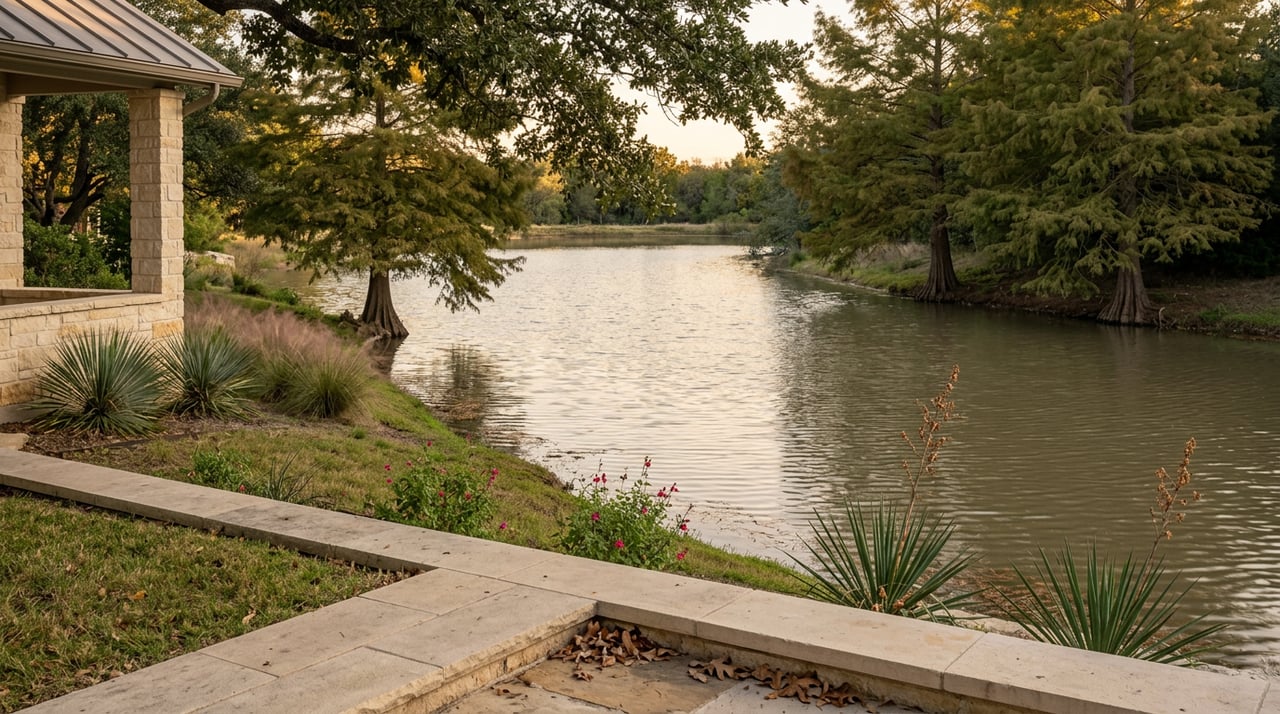
Why Frieden's Short-Term Rental Ban May Protect Value
Why would a Hill Country developer, two miles from a wine-country Main Street busy with weekend visitors, write a rule into its covenants that turns away nightly rental income entirely?
That is the question a lot of buyers skip past when they first tour Frieden. They hear "no Airbnb, no VRBO, no B&B bookings" and file it under restrictions, next to the architectural guidelines and the three-year build clock. But look at what has happened to short-term rental pricing in Fredericksburg over the past six months, and the rule reads less like a restriction and more like a decision the market is quietly validating.
Frieden is governed by a property owners association rather than a traditional HOA, and its current FAQ is direct on the point: short-term rentals such as Airbnb and VRBO, along with private bed-and-breakfast bookings, are not allowed. The same FAQ puts the POA fee at $250 a month per residence and estimates build costs between $250 and $350 a square foot, on top of whatever the homesite itself costs. Buyers get roughly three years from purchase to start construction, with plans reviewed by Frieden's architectural committee before the City of Fredericksburg ever sees them.
None of that is unusual for a planned community. What is unusual is closing off the income lane entirely, in a market where that lane has historically commanded a real premium.
Here is the part most buyers never see laid side by side. In the first half of 2026, the average sale price per square foot on short-term rental transactions in Fredericksburg fell to about $411, down from roughly $436 at the close of 2025. That is a decline of nearly 6 percent in six months, in the segment of the local market that has historically traded at the highest premium per square foot.
Owner-occupied homes inside Fredericksburg's city limits moved far more gently over the same window, down closer to 3 percent for the first half of 2026. For context, Austin's broader home values pulled back closer to 7 percent over the trailing year, so a 3 percent softening in Fredericksburg's owner-occupied segment counts as comparatively steady footing. The short-term rental segment, by contrast, is absorbing roughly twice that correction.
Put the two side by side and the pattern is plain:
| Segment | H1 2026 price-per-square-foot move |
|---|---|
| Fredericksburg owner-occupied, city limits | down roughly 3 percent |
| Fredericksburg short-term rental sales | down roughly 5.7 percent (from about $436 to about $411) |
| Austin home values, trailing year | down roughly 7 percent |
The STR segment is the most volatile lane in the local housing market right now. It is also the exact lane Frieden's covenant closes off, permanently, for every home in the community.
Some of that volatility traces back to a regulatory environment that has been tightening. Fredericksburg's short-term rental ordinance, first built out under Section 20.222 of the Zoning Ordinance and effective January 1, 2024, was updated again effective January 1, 2026 to add mandatory annual inspections at every permit renewal, not just at issuance or ownership transfer. A property that already held a permit does not skip this. Every renewal now triggers a fresh inspection.
Operators also owe a combined 13 percent hotel occupancy tax on every stay, split 7 points to the city and 6 to the state. New permits for unoccupied short-term rentals face tighter siting rules inside purely residential zoning districts, and the city has not issued new short-term rental condo permits since 2024. None of this makes running a compliant short-term rental in Fredericksburg impossible. It makes it a business, with a permit cycle, an inspection calendar, and a tax filing obligation that a homeowner has to actively manage year after year.
A Frieden buyer never enters that system. There is no permit to renew, no annual inspection to schedule, no zoning map to check before closing. The trade is not abstract. It is the difference between owning a home and operating a small hospitality business inside it.
Be clear about the other side of the ledger. The $250 monthly POA fee and the $250 to $350 per square foot build cost have to be carried entirely out of pocket or offset by personal enjoyment, since there is no nightly rate to lean on. For comparison, the median monthly HOA or condo fee across Gillespie County runs about $287, based on figures verified in July 2026. Frieden's fee sits at or below that county median, which tells you the fee itself is not a premium charged in exchange for the amenities. It is closer to a standard cost of shared trail and lake maintenance, without an income stream attached to help absorb it.
If your goal for a Hill Country property is to generate rental revenue, whether to offset the mortgage or to build a standalone investment, Frieden's rule takes that goal off the table before you ever draw up a floor plan. That is a real cost, and it should weigh as heavily in your decision as the architectural guidelines or the lake views.
What the covenant buys in return is a form of insulation the rest of the local market does not have. Frieden's resale value cannot be pulled down by a soft season of nightly rates, a new state tax rule, or a city council vote tightening occupancy limits, because none of those levers touch a home that was never priced against rental income in the first place. Every home in the community is competing on the same terms: personal use, architectural consistency, and long-term ownership. There is no adjacent unit quietly undercutting comparable sales because its owner needs a certain occupancy rate to make the numbers work.
That is a different kind of stability than a low HOA fee or a scenic lot provides. It is structural, and it is baked into the deed restrictions rather than dependent on market sentiment holding steady.
If short-term rental income is part of your plan for a Hill Country purchase, look outside Frieden, and pay close attention to whether the property sits inside Fredericksburg's city limits or in its extra-territorial jurisdiction, since that line determines whether a city permit applies at all. If your goal is a Hill Country home whose value is not riding the same cycle as the nightly rental market, Frieden's rule is not the caveat buried in the fine print. It is the point of the community.
Neither answer is wrong. The mistake is treating the no-STR rule as a simple restriction rather than as evidence of how the developer expects this property to hold its value over time, and the first half of 2026 gives you the data to judge whether that bet is paying off.
Can the POA change the short-term rental rule later? Restrictions like this are written into Frieden's covenants and design guidelines, which govern the community as a whole rather than lot by lot. Any change would require the kind of formal amendment process that applies to POA governing documents generally, not a simple vote by a single owner or board decision made in isolation.
What about longer stays, like a 60-day corporate rental or a family member staying for a season? The rule specifically targets short-term rental platforms and private bed-and-breakfast bookings. If you are weighing a longer-term arrangement, review Frieden's current covenants and design guidelines directly, since the FAQ addresses the platforms it prohibits rather than every possible occupancy scenario.
Does the ban hurt resale value? The first half of 2026 suggests the opposite may be closer to true. The segment of the Fredericksburg market carrying the steepest price correction right now is the one built on short-term rental income. A covenant that keeps a community's pricing tied to owner-occupancy rather than nightly rates is, at minimum, a form of protection from that specific volatility.
If you are comparing Frieden against other Hill Country options and want to see how this trade actually plays out on a specific address, reach out to Mimi Bartel and Adam Carroll. Their read on Fredericksburg's market runs deeper than a covenant summary, and they can walk you through exactly what a given lot, home concept, or resale property would mean for your specific goals. Search Homes to see what is currently active in and around Frieden today.


Our approach is rooted in strategy, insight, and uncompromising professionalism. With advanced academic credentials and experience in advisory, mergers and acquisitions, and multi-million dollar production, we bring analytical precision to every negotiation. We believe luxury is defined not only by property, but by experience — seamless execution, clear communication, and results that exceed expectation.
Mimi Bartel
Adam Carroll
605 N Llano St Fredericksburg, TX 78624